Inside the wire
Team Rubicon’s mission to engage veterans in service
“That’s not a lake, bro,” Mike Binnig says, nodding at the mirror-like expanse outside the truck window. “It’s a cornfield.”
Surrounded by water on each side, Jewell City Road in Hopkins County could pass for a bridge. Weeks after the flood that began on April 2, the air still reeks of river mud and rotting plants.
At the work site near Slaughters, a muddy line nearly 3 feet high scrawls the path of the Green River where it poured through a home like a sieve. The living room floor flexes underfoot, spongy and damp. River water sloshes in a brown sofa’s storage compartment, and a thick growth of mold slicks the wall.
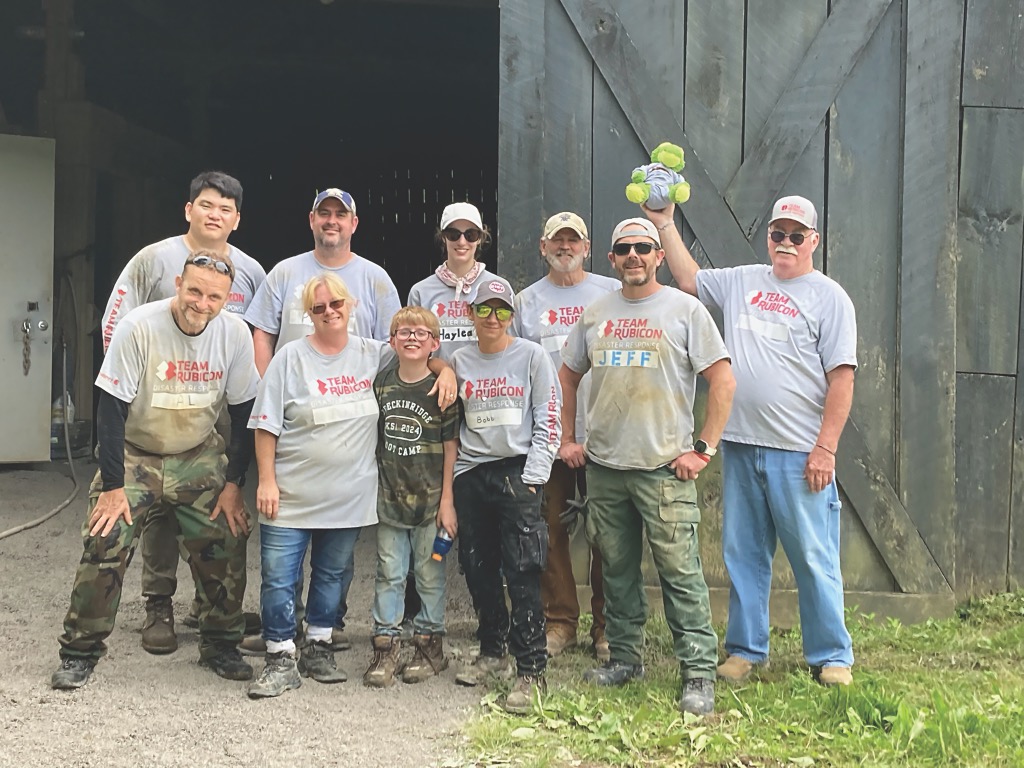
Binnig is one of a couple dozen volunteers deployed with Team Rubicon—a veteran-led disaster response organization. Volunteers arrive on site with plastic gloves, masks, crowbars and hammers. An empty dumpster is ready and waiting. They’ve come from 13 states—retirees, young parents, veterans, firefighters, first responders and civilians—to serve communities in Christian and Hopkins counties.
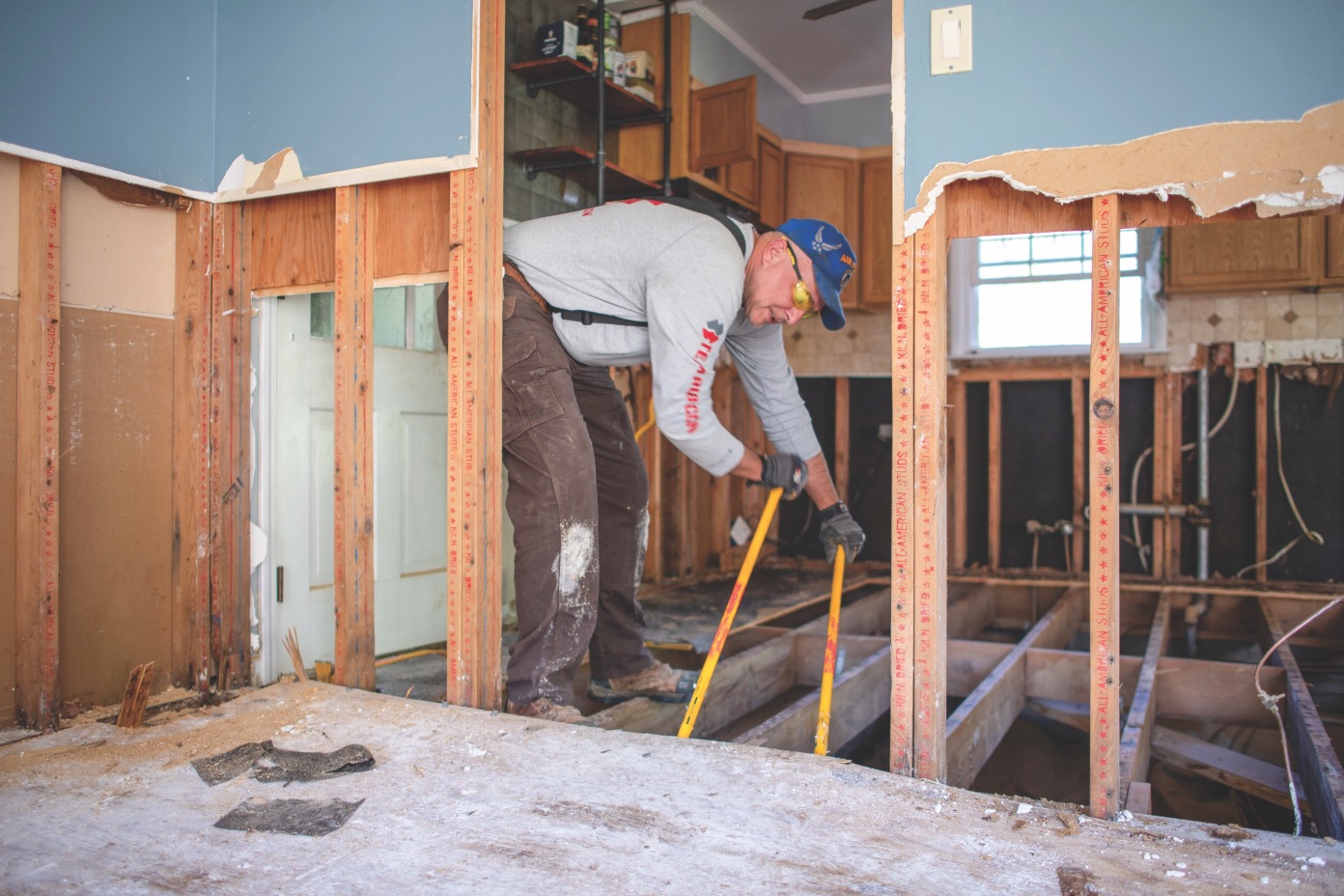
Rick Kievert removes damaged material from a flooded home. Photo: Jason Whitman/Team Rubicon
When a local news station shows up to interview volunteers, the reporter asks Rick Kievert, a 20-year Air Force veteran, why he got involved with Team Rubicon. The answer makes him emotional—he missed being part of the military family.
During breakfast that morning, he’d said something similar. Military service changed him, and he expected people to have his back. That didn’t always happen in the civilian sector.
“I missed being inside the wire,” he said. “And I figured this”—he gestured around the makeshift mess hall—“is the closest I can get.”
BUILT TO SERVE
Team Rubicon was born in 2010, when Marine veterans Jake Wood and William McNulty led a small team of volunteers to respond to the magnitude 7 earthquake that devastated Haiti. During its first year, volunteers primarily deployed overseas. But after one of the original team members, Clay Hunt, died by suicide in 2011, Team Rubicon shifted its focus to domestic disaster response and veteran engagement.
Since its founding, Team Rubicon has grown to more than 200,000 volunteers, serving nearly 3 million people in more than 700 communities in 2024. The organization welcomes volunteers from all walks of life, including civilians, but remains focused on providing community and service opportunities for veterans.
Toni Wells, a Blue Grass Energy consumer-member from Nicholasville, is Team Rubicon’s volunteer statewide administrator. Since she got involved in 2020, Wells has seen the difference service can make—not only for people impacted by natural disasters, but also for the volunteers who respond.
“Veterans need to feel needed,” Wells says. “We have to have a purpose. For 12 straight years, I had nothing but mission, mission, mission. … When you get out, it’s not like that. But with Team Rubicon, it’s like, ‘Hey, I got you. We can do this together.’”
Wells lays the groundwork for response when disasters appear on the horizon. Before tornadoes touch down or floodwaters rise, she’s on the phone with emergency planners from areas that will be affected. When it’s safe to travel, she coordinates teams to visit communities and assess needs. She finds billeting—a place to sleep, in civilian-speak—and issues a call for volunteers, who are known as Greyshirts. When the operation is prepared and fully staffed, she hands it off. By then, she’s already looking for the next clouds on the horizon.
Wells’ path to Team Rubicon was shaped by her military experience. During 9/11, she served in the Military District of Washington Engineer Company—the U.S. military’s only technical rescue unit. Her fellow soldiers were among the first responders to arrive at the wreckage of the Pentagon, but Wells, recovering from back surgery, had to coordinate from afar. She still feels guilty she wasn’t there to support her unit. Team Rubicon is her way to be there now.
“I think I use it as sort of a redemption for what I wish I would have done,” she says. “What I wish I could have done.”
ROLL CALL
The lights flick on at 06:00 in the billeting area, a church gymnasium lined with folding cots and neat piles of personal belongings. Blinking in the fluorescent glare, the volunteers who aren’t already awake roll out of bed to prepare for the workday.
At the breakfast table, Operations Section Chief Randy Catlette nurses a black coffee and shares his Team Rubicon story. A Blue Grass Energy consumer-member from Richmond, Catlette served 20 years in the Army, then nearly two decades more as a firefighter. But he realized he was slowing down. One day he was the last firefighter to climb onto the truck—something he always swore would never happen.
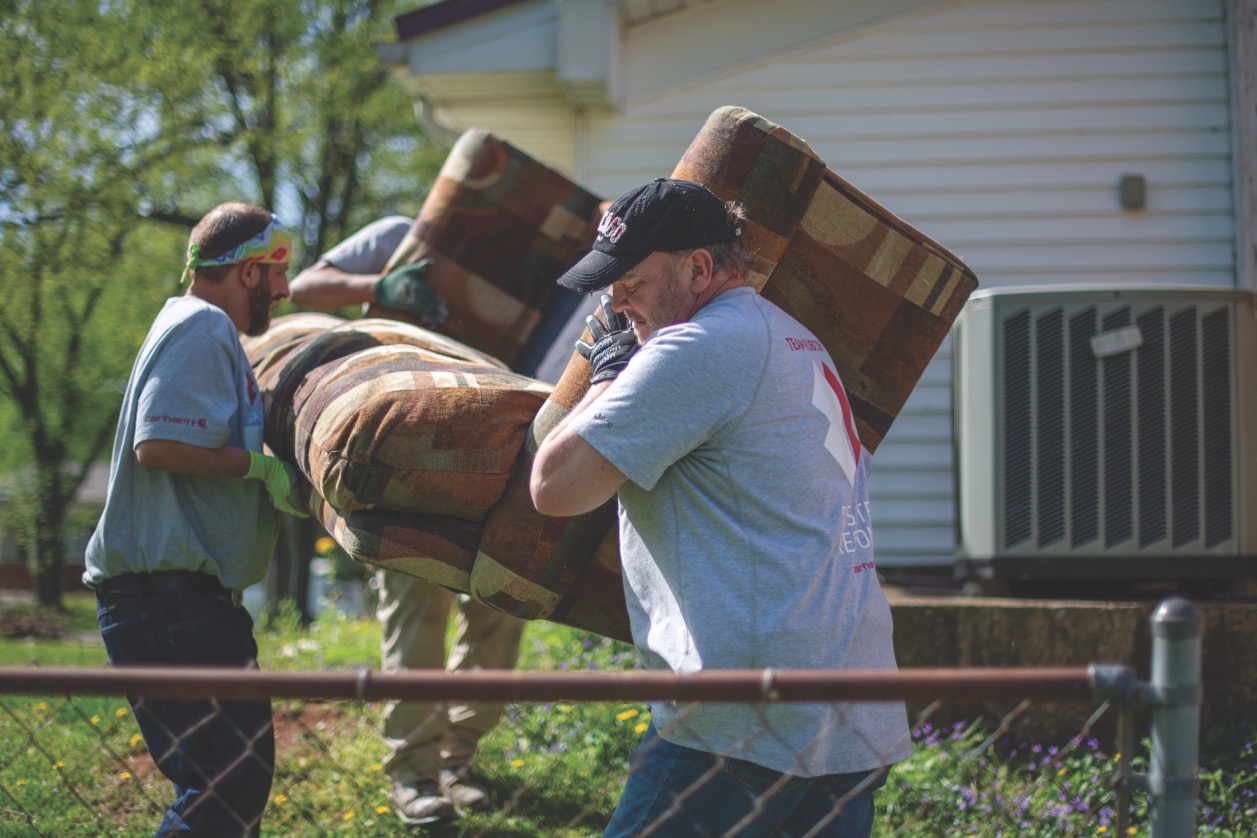
David Weller, left, and Todd Klein carry a damaged sofa. Photo: Jason Whitman/Team Rubicon
After he dislocated his shoulder for the fourth time, he couldn’t fool himself any longer. He retired from the fire department and signed up to deploy with Team Rubicon, completing the online training with one arm while his bum shoulder healed.
For many veterans, Team Rubicon provides coherence. Its top-down, organized, no-excuses method of tackling problems makes sense. And some find that service can help them make sense of themselves.
Catlette has heard all kinds of stories around the campfire—a Team Rubicon evening ritual observed with near-religious devotion. He says he’s met veterans who were “ready to pull the trigger” before they deployed, but somewhere in the muck and the sawdust and the camaraderie of service, they found what they needed.
“Team Rubicon saves lives,” Catlette says. He coughs and wipes an eye, shoves his chair back from the table and walks away.
UNSEEN BATTLES
Team Rubicon’s core mission is engaging veterans and other volunteers in disaster relief. But when volunteers like Wells talk about the organization, it’s the sense of community that matters most.
“We’re there for each other,” Wells says. “We are our social support system and mental support system.”
U.S. veterans experience mental health disorders and die by suicide at significantly higher rates than the general population. According to the Department of Veterans Affairs, 6,407 veterans took their own lives in 2022— an average of 17.6 per day. Prevention requires not only clinical intervention, the VA says, but also the reduction of risk factors and the strengthening of protective factors “like access to mental health care, feeling connected to other people, and positive coping skills.”
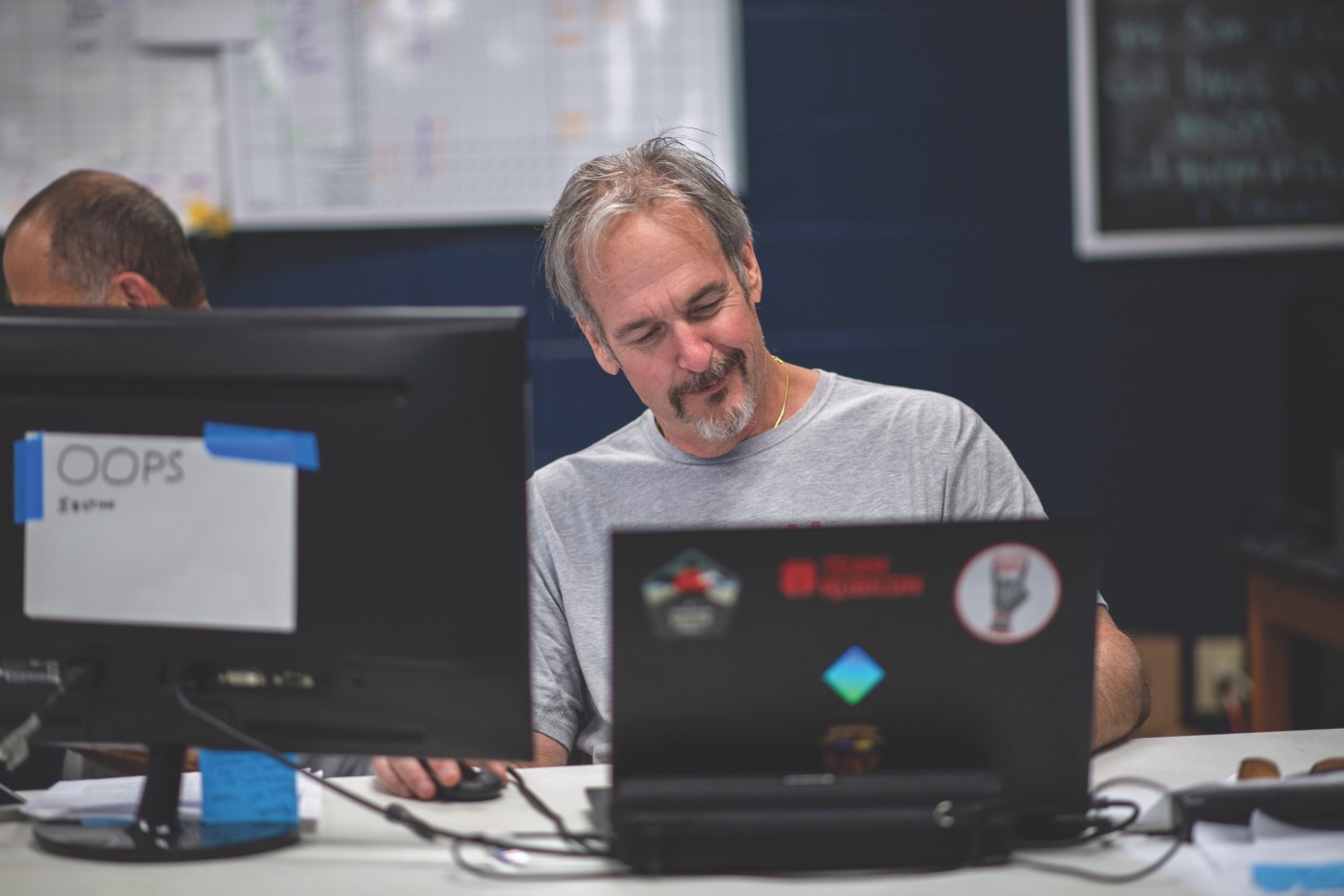
Randy Catlette serves as operations section chief during an April response in Hopkins and Christian counties. Photo: Jason Whitman/Team Rubicon
Volunteering can make a difference, too. A 2016 study of 346 post-9/11 veterans found that volunteering “was associated with significant improvements in health, mental health and social outcomes in returning veterans.” VA Press Secretary Pete Kasperowicz cautions, however, that volunteering is an additional tool, not a replacement for medical care for mental health conditions such as post-traumatic stress disorder. “We encourage veterans to contact their local VA Medical Center to seek support and treatment,” he says.
“Team Rubicon has definitely helped me connect with many like-minded people, like those I served with in the military,” says Jim Laman, a Team Rubicon operations manager from South Carolina who served seven years in the Marines. Following the catastrophic flooding in eastern Kentucky in 2022, Laman deployed to Letcher County, where he spent a week mucking out flooded homes.
“Regaining a sense of purpose by serving communities in need, and the camaraderie that comes from connecting with those of similar backgrounds and life experiences, are huge in helping preserve your mental health,” he says.
The outward-focused nature of Team Rubicon’s work—bringing relief on the worst day of someone else’s life—is what resonates with Wells.
“I hate to see anybody hurt, and I’m a fixer,” she says. “If I can help somebody and make them feel better, that’s what we’re here to do.”
RECOVERY AND RELIEF
In Slaughters, the strike team is assembled and ready to muck out the flooded home. Hopkins County Judge-Executive Jack Whitfield, who has been checking on residents, pulls the team together for a prayer before work begins. He asks for safety and offers thanks for the group of volunteers who’ve come to help “people who they don’t know, but who they love.”
Strike Team Leader Heather Carpenter, an Army veteran from Ohio, walks through the home, taking instructions from the homeowners. When she gives the green light, it’s time to work. Donning masks and gloves, Greyshirts methodically store salvageable goods in the home’s garage for cleaning, hauling the remainder to the dumpster out front. They pull up carpet and linoleum, piling logs of sodden material into plastic sleds and skidding them outdoors. They open any windows that aren’t swollen shut, circulating air to help the structure dry.
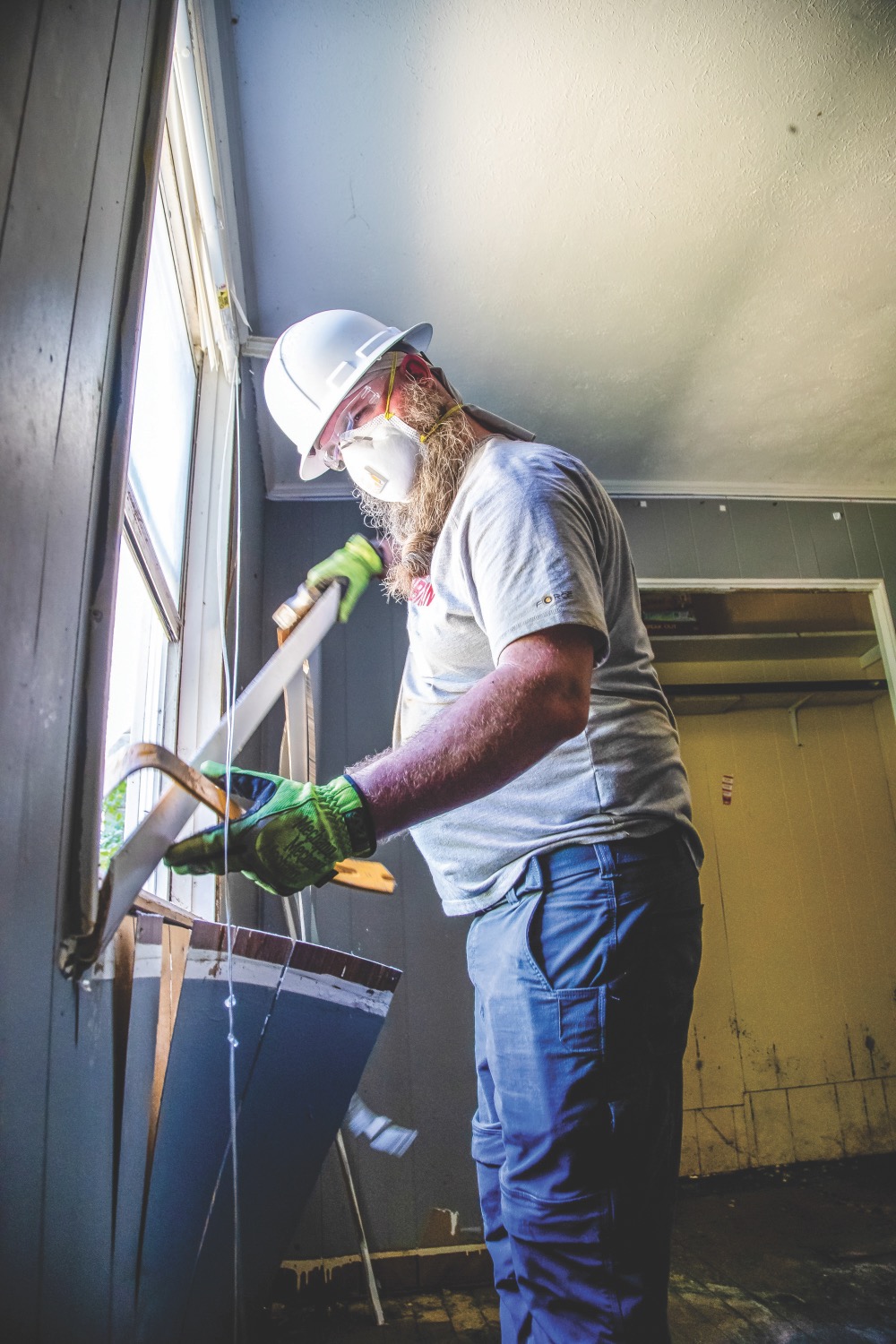
Jim Laman removes moulding from a window in a flood-damaged home in Letcher County in September 2022. Photo: Carlos Chiossone/Team Rubicon
Jesse Breedlove, the deputy director of emergency management in Hopkins County, stops by several times throughout the day. He first connected with Team Rubicon following the tornado that tore through western Kentucky in 2021. The organization’s chainsaw crews were “a massive help” in cleanup efforts, Breedlove says. “If there’s a need, they try to facilitate it the best way they can.”
Hours creep by, and the heap in the dumpster grows taller. By late afternoon, it’s piled to the top. The house is empty. The walls and floors are bare. Dried river mud cakes volunteers’ clothes. They put away their tools, load the trucks and head back to the church—the forward operating base, or FOB, in Team Rubicon’s military lexicon.
After the last dishes are washed, a handful of Greyshirts mill around the firepit out back. They trickle in as the light fades, catching up on the day’s work, telling jokes and talking about their families. But there’s more to hear, if you listen—stories of battles lost and battles won.
“Team Rubicon, especially around the campfire, it’s a safe space,” Wells says. “You can talk, you can tell people how you feel, and there’s no judgment. It’s just acceptance. And that’s what keeps me here.”
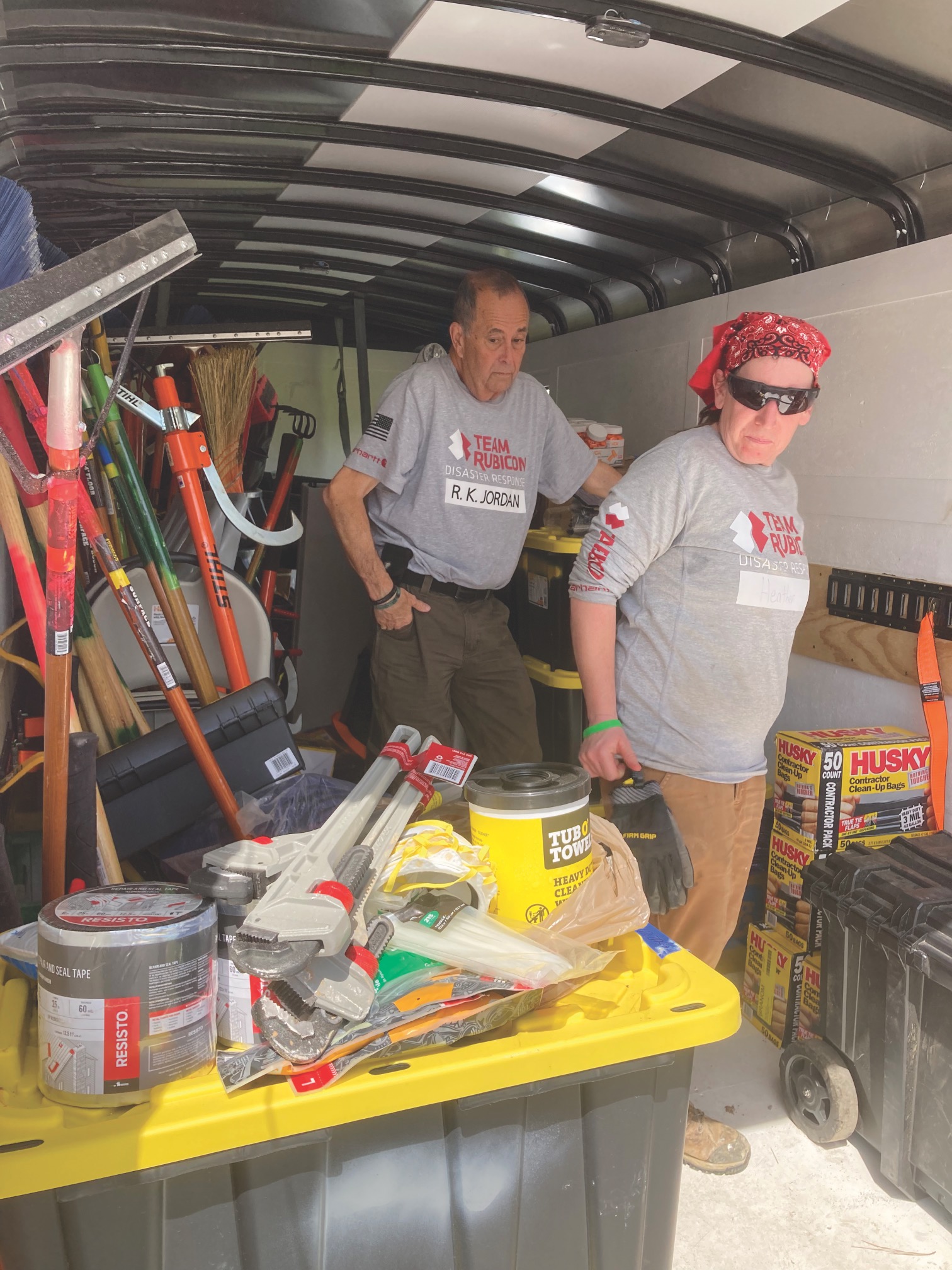
Alpha Team Leader Heather Carpenter selects tools and supplies with Logistics Section Chief R.K. Jordan. Photo: Joel Sams
Team up with Team Rubicon
To volunteer with Team Rubicon, you must be at least 18 years old, pass the required background check and complete an introductory training. Follow these five steps to get started.
- Register on RollCall. Visit rollcall-events.teamrubiconusa.org to create an account and begin the process to become a Team Rubicon volunteer.
- Build your deployment profile. This is your opportunity to share your skills, interests and goals.
- Pass a background check. This process is facilitated through the RollCall platform to ensure a safe environment for Team Rubicon staff and volunteers, and the communities they serve.
- Complete TR101. This introductory training is all you need to get deployable—but there’s plenty more to learn when you’re ready.
- Earn your shirt. You’re ready to go and will receive email invitations to deploy on operations near you.
Once you’re deployable, there are multiple ways to serve and opportunities for all levels of ability, from behind-the-scenes work to field operations. If you don’t want to volunteer, you can also donate, helping Team Rubicon provide services to individuals and communities at no cost. Learn more at teamrubiconusa.org.