‘The storm pushes back’
Kentucky’s electric cooperatives power restoration after a relentless Winter Storm Fern
Winter Storm Fern didn’t deliver a single blow to Kentucky’s electric grid — it delivered a series of them.
Beginning Sunday, January 25, the storm brought snow, sleet, rain and freezing rain across all of Kentucky, with ice accumulations highest in southern Kentucky.
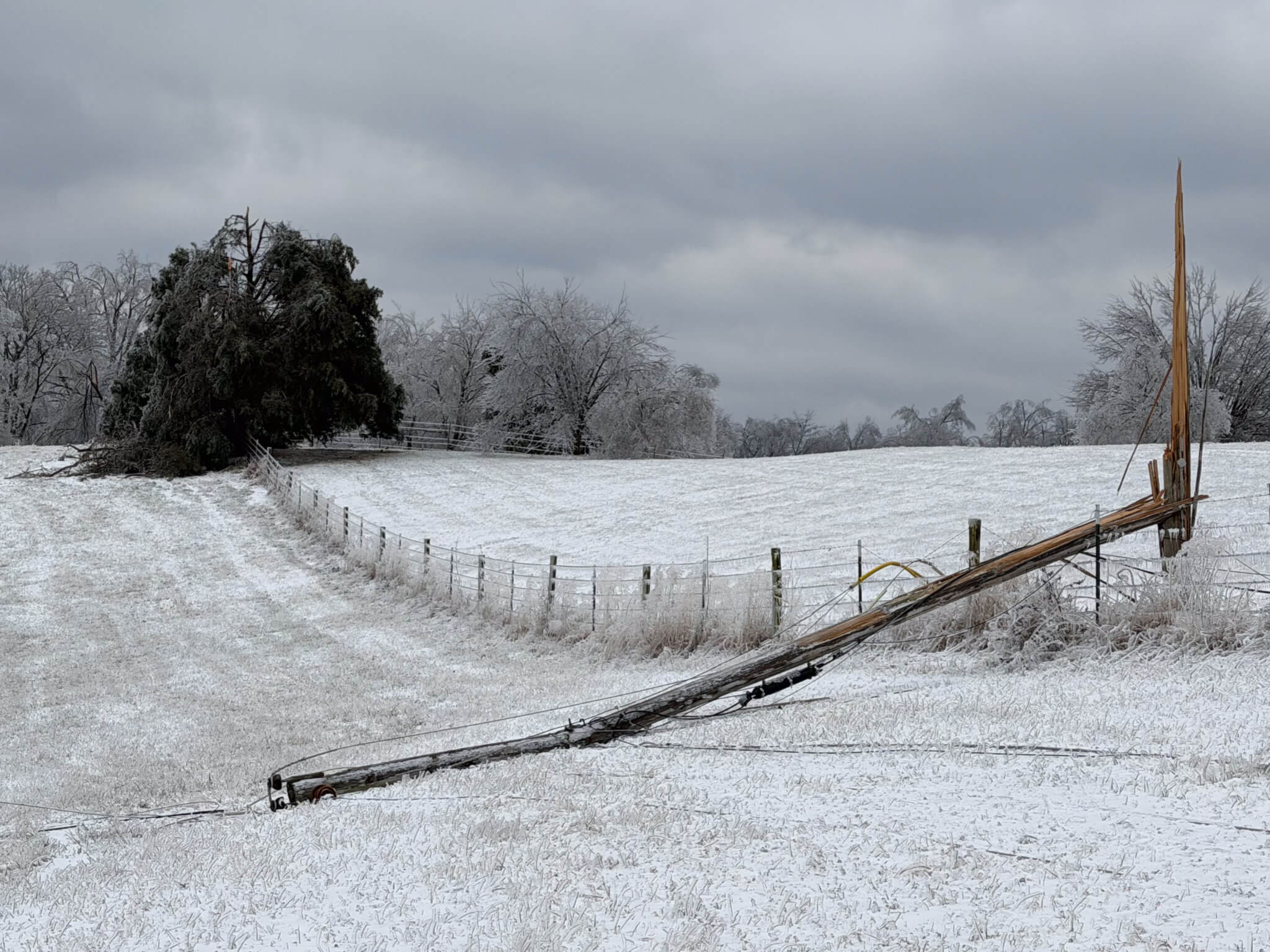
Six of Kentucky’s 24 local distribution cooperatives took the worst of it as 3/4 of an inch of ice coated trees, power lines and equipment, triggering widespread outages. At the height of the storm, more than 68,500 cooperative members were without power statewide.
By Thursday morning, that number had dropped to just under 6,000, the result of a coordinated, weeklong restoration effort that relied on manpower, mutual aid, clear communication — and in some cases, eyes in the sky.
A storm that didn’t move in a straight line
As crews worked through the event, progress rarely followed a smooth curve. Big gains early in the week were followed by slower, more deliberate restoration as crews moved into the final phase — where each remaining outage often affected only a few homes but still required the same careful, time-intensive repairs.
Tri-County EMC President and CEO Glenn Hale cautioned members early that this kind of storm doesn’t follow a predictable path.
“We’ve made significant progress restoring power, but ice storms don’t move in a straight line,” Hale said. “As we restore service in one area, ice and wind can cause new outages in another. That’s why crews are constantly being redeployed across our system, and why we won’t release any of these crews until we have the situation fully under control.”
Tri-County has 19 substations and almost 5,500 miles of distribution line across eight Kentucky counties and seven more in Tennessee, the state that tallied the most power outages of any in this storm, more than 250,000.
“This is one of those storms where you make progress, then the storm pushes back,” he said. “Our crews are staying on it until every member who can be restored has their power back.”
Those setbacks weren’t unexpected. Ice storms often cause progressive damage — limbs weakened early can fall days later, equipment stressed by ice loads can fail after power is restored, and temperature swings can trigger repeated problems along the same circuit.
South Kentucky RECC: assessing damage from above
In south-central Kentucky, South Kentucky RECC faced some of the most severe impacts of the storm. Along with deploying hundreds of personnel, the co-op turned to drones to improve damage assessment and crew safety.
“From the ground to the air, it’s all hands on deck, using everything at our disposal, including drones, to assess damage and locate outages more efficiently — to get members back on as safely and quickly as possible,”said Morghan Blevins, spokesperson for South Kentucky RECC.
The aerial views allowed crews to spot broken poles, damaged lines and hard-to-reach trouble areas that might otherwise require long, hazardous patrols on icy terrain.
Even with those tools, the final stretch proved demanding. By Thursday morning, South Kentucky RECC was dealing with hundreds of small, scattered outages — many already assigned to crews — each requiring detailed, hands-on work.
“We sincerely thank our members for their patience and understanding,”Blevins said. “We know this is a very difficult time, and we want you to know our crews are working tirelessly to restore power as quickly and safely as possible.”
Farmers RECC: when the last outages take the longest
For Farmers RECC, the challenge wasn’t just restoring power — it was doing so safely in conditions that kept getting worse before they got better.
Toby Moss, president and CEO of Farmers RECC, said restoration slowed during the storm because of extensive damage and dangerous working conditions.
“Restoration was slow during this winter storm due to extensive damage and hazardous conditions, including downed trees, damaged power lines, broken poles and icy roads,” Moss said. “As temperatures dropped throughout the event, the thawing and refreezing cycle led to more damage than what we began with. Crews were forced to climb many poles to complete repairs, which extended the length of outages.”
As Farmers moved closer to full restoration, the work became even more targeted.
“As we neared complete power restoration, we knew those final members were anxious to have their power restored,” Moss said. “At this stage, crews may work hours on an outage that restores service to only a few members because of the outage-to-member ratio.”
Farmers RECC also used social media to reinforce safety — including sharing video taken by lineman Chad Thompson after a downed line was confirmed de-energized. Even so, the footage showed how electricity can still be present when a line falls, underscoring why members are urged to stay well clear of downed lines.
Jackson Energy: the final push
In eastern Kentucky, Jackson Energy reached the final phase of restoration earlier than many systems, but leaders emphasized that “almost done” still requires full focus.
As repairs narrowed to the last locations, Lisa Baker of Jackson Energy highlighted the behind-the-scenes coordination that made progress possible.
Dispatch operators coordinated the recovery around the clock, keeping linemen moving efficiently and safely toward the remaining outages. Field crews, mutual aid partners, member service representatives and support staff all played critical roles as the system pushed toward completion.
Crews focused on small, labor-intensive outages involving damaged poles, broken lines and difficult terrain — often requiring specialized equipment and additional time to complete safely. Restoration timelines fluctuated as crews encountered new challenges, but the goal never changed: restore every remaining member safely.
Co-ops helping co-ops
Throughout the week, mutual aid crews barreled in from more than 20 electric cooperatives in Kentucky and neighboring Illinois, in addition to assistance from municipal utilities and hundreds of contract crews. In many cases, co-ops that restored power early immediately sent crews and released contractors to assist others still deep in restoration.
It’s a defining feature of the cooperative model: when one system is overwhelmed, others step in.
The last miles
By Thursday morning, restoration across Kentucky had clearly entered the endgame. Progress was slower and often out of sight, but no less intense.
Winter Storm Fern served as another reminder that ice storms don’t end with a single repair or a single switch — they end with patience, persistence and careful work, sometimes restoring power one member at a time.