Kentuckians work together for foster kids
HAVE YOU EVER SEEN a state government webpage that simultaneously warmed and broke your heart?
If not, then you’ve probably never visited the homepage for Kentucky FACES, an acronym for the Foster Adoptive Caregiver Exchange System. The website is a clearinghouse for information about Kentucky children who’ve been removed from their homes, often due to parental abuse, neglect or drug addiction.
On that page, you’ll find a link to view photos of waiting children, and you’ll get to meet a few of the roughly 8,700 children in the state’s foster care system. Many of them are featured in photos with short write-ups, and some have two-minute videos, like the one in which 14-year-old Abbie confesses her love for pandas. “I’ve never been to a zoo,” she says, “but I’ve always wanted to go see one.”
Elijah, 15, says, “Something I want people to know about me: I’m a loving, caring person. And I care about everyone. Every living thing.”
Connor, 13, says, “If I could have any superpower, it would be making people do the right thing.”
There are 38 pages of profiles like these from Kentucky children, many of whom have seen terrible things. And yet, in their pictures and videos, their smiles shine through, along with their energy and sense of hope that they will be chosen.
Granting that wish, and keeping foster children safe, are the goals of a broad network that includes state agencies, the family court system, nonprofits, volunteers, donors and, of course, the caring people willing to open their homes to these children.
Lesa Dennis is commissioner of the state’s Department for Community Based Services, which oversees foster care in Kentucky. Dennis says the need for foster parents is great. While there are 8,700 children in foster care, there are fewer than 4,600 approved foster homes in Kentucky.
The good news is “we have lots of homes that are willing to take that 5 and under population,” Dennis says. “But what we struggle with is foster homes that are willing to accept older youth 12 and above.” Sibling groups are also hard to place, and so are children with serious health needs or behavioral issues. Those needs are not uncommon among young people who’ve experienced trauma, which often precedes a child’s entry into the foster care system.
Inside the system
The removal process generally begins when state or local authorities get reports of a child showing signs of possible abuse or neglect. A social worker visits the home, and sometimes a court-appointed child advocate does as well.
They complete individual interviews with the child, the parents or other caregivers when present, and others who may have relevant information. They write reports, sometimes with recommendations, that are reviewed by a family court judge, who determines whether to leave the child where they are—possibly with additional support for the family—or to remove them from the home and take the child into state custody for the child’s safety.
Dennis stresses that the department’s goal is reunification. “So we want to reunify that child with their biological parents if at all possible,” she says. The bond between biological parents and children makes the decision to remove a child agonizing for all involved. The court must decide whether to leave a child in a potentially dangerous or traumatizing situation at home, or to remove the child, which can be traumatic in itself.
Jackie Kennedy has seen these moments up close many times in her 18 years as a court-appointed special advocate in Murray. A consumer-member of West Kentucky RECC, Kennedy volunteers with CASA by the Lakes, a chapter of Court Appointed Special Advocates, a nonprofit that works on behalf of children in the child welfare system. “I’ve had some hard cases,” she says. In Kennedy’s experience, most children are reluctant to leave even abusive homes, except in the most extreme circumstances. She remembers working with a brother and sister who were 5 and 8 years old. “They had tears in their eyes and they were clinging to each other,” she says. She encourages foster parents to have patience and show the children you care. “Then they’ll start responding to you,” she says, “They need you.”
Whatever their experiences, foster children are understandably anxious as they face the unknown world of a stranger’s house. Likewise, foster parents take a leap of faith as they welcome a child they’ve never met into their home.
Welcoming homes
Laura and Brandon Priest have taken four foster placements through Operation Open Arms, a Louisville-based nonprofit that identifies foster homes specifically for the children of incarcerated mothers. The Priests adopted three of those foster children, and adopted one child internationally. They also have two biological children, who are not the oldest of the six, but did arrive first.
Brandon says, “We always wanted to have a purpose for our family to not just live life, but to help others.” Laura adds that at some point even after they became parents to their biological children, “I felt like something was missing from our family and that (fostering) was something that we could do. And so it was something that we should do.”
With each addition, Laura and Brandon have discussed the process and their rationale with the entire family. “We talk to our kids a lot about this being a ministry for all of us,” Laura says. “It’s not something that Brandon and I do, but that we all do.”
The couple acknowledges the challenges, the questions foster children ask about what’s happening and why, the trauma behavior they’ve seen and the forgiveness they’ve had to offer—and ask for. Do the satisfactions outweigh all of that?
“Absolutely,” Laura says.
As evidence, during a Zoom call to discuss their foster experience, all six of their children crowded their way onto the screen, debating the dinner potential of pancakes versus tacos, and describing pastimes that included Minecraft, soccer and tackling one another. Asked what the world might need to know about their parents, one of the Priest children says, “They love us.”
Resilience and reform
Alongside success stories, however, there are also stories of children whose behavioral issues overwhelmed even well-intentioned parents’ capacity. In addition, while foster parents are vetted and receive training, it’s not hard to find stories of foster children who had difficult or even painful experiences with their foster parents. Twenty-year-old Ariana Rodriguez spent years of her childhood in kinship care— in which she lived with a relative—and foster care, sometimes separated from her younger brother and sister. She felt her primary foster parents treated them with indifference, and that communication was often lacking.
“Nobody tells you what’s going on,” she says. “It’s a very dehumanizing experience.”
Rodriguez spent her late teen years in Bardstown and lived in her car for part of the time she was going to high school, before moving to Lexington to attend the University of Kentucky. In May, she was named Miss Kentucky, the first foster care alum to earn that honor. Advocating for foster children is a central part of her platform, and she’s also founded a nonprofit, The Lucky Ones, to support young people in foster care and elevate their voices.
“When you’re in the system, you’re told, ‘You’re so resilient. Keep doing what you’re doing,’” she says. “But sometimes you just need someone to say… ‘What do you need right now? What do you want to talk about?’”
Dennis says there are more mechanisms in place now to incorporate the voices of foster children and alums into the process of reform—a process most acknowledge is needed. Multiple news reports in recent years have detailed how foster children in Kentucky and other states sometimes end up sleeping temporarily in hotels or state offices.
When that has happened, Dennis says, it’s because there have been too many foster kids and not enough foster homes. “We’ve had youth which we had not been able to find treatment and placement for,” she says, so the department accommodated them where it could, always providing supervision.
And yet, while the foster care system is filled with complications and imperfections, it also produces stories of connections made and wounds healed—of kids, and parents, who faced the unknown together and found each other.
As it happens, one source of examples can be found on another surprisingly emotional taxpayer-funded webpage within the Kentucky FACES section of the Cabinet for Health and Family Services website. It’s under the heading “Testimonials.”
Angie Carter: “Fostering has filled our home with children, laughter and happiness!! It’s an honor to be a part of the girls’ lives!!”
Brian Lovell: “Each soul in my home changed my heart, and I like to think I changed theirs some, too. …If you’re considering fostering, my advice is to take the first step and start working toward it! You’ll never know how rewarding and challenging your road will be until you are on it!”
Penny Davis: “People often say, ‘This child is blessed to have us.’ I simply say, ‘No, if they were blessed, they would have their mom and dad tucking them in bed every night at home. The real truth is that we are blessed to have them…’.”
Meet Miss Kentucky
From childhood, Ariana Rodriguez had a vision that one day she would be successful. That conviction helped carry her through many difficult moments growing up in foster care, kinship care, experiencing homelessness and more. Rodriguez was removed from her mother’s care at age 5, then spent years living with relatives and in foster care, changing houses about 20 times by age14 and living out of her car for much of high school.
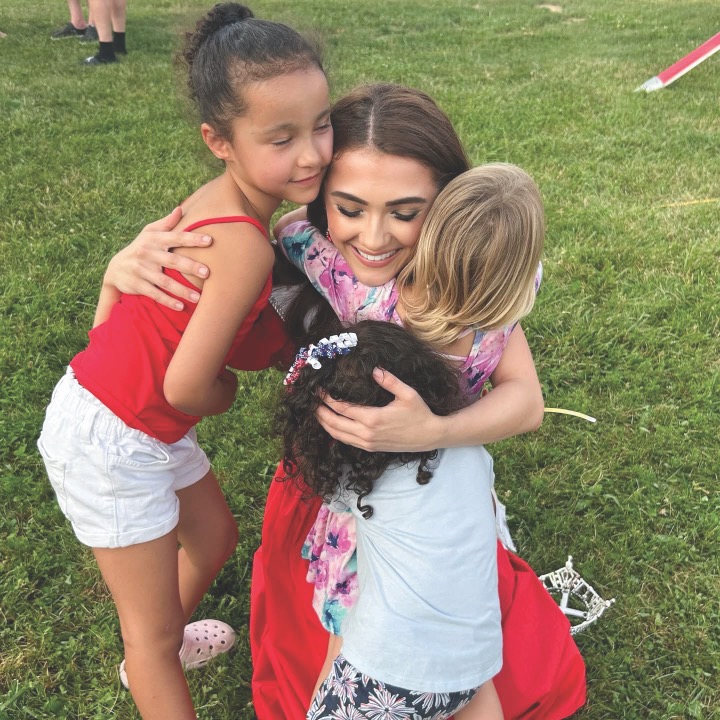
Ariana Rodriguez was
named Miss Kentucky in
May. Her nonprofit, The
Lucky Ones, supports
foster children. Photo:
Rob Metzger Photography
Her experience in the child welfare system makes Rodriguez’s victory in the 2025 Miss Kentucky pageant that much more unusual. In May, she became the first foster care alum to earn that title, and went on to finish in the top 11 in the Miss America pageant. She’s also founded her own non-profit, The Lucky Ones, to support children in foster care and to raise awareness about the challenges they face. In the following interview, which has been edited for clarity, Rodriguez talks about getting through the challenges she faced and her experience winning Miss Kentucky.
KENTUCKY LIVING: What was your experience like in foster care?
RODRIGUEZ: My brother and I were this woman’s first-ever foster care placement. Our sister was separated from us. The woman was 73 and her husband was 82. We barely spoke unless she was telling us to do chores. I had really bad anxiety and would have panic attacks almost every day. She would tell us that we were one of the lucky ones and we should be grateful that we don’t have it worse.
KL: Later, you and your brother and sister were reunited with your biological mother. What was that like?
RODRIGUEZ: We lived out of an abandoned house for a year when I was 14. We didn’t have running water. We didn’t have electricity. We took baths using rainwater and cooked by making a fire outside. But we did things like any other family. We’d go outside and climb trees and play. Just trying to enjoy our childhood as much as possible. When I got to high school, I saw that, although my mom wasn’t doing drugs, she was falling into the same old patterns and it was really hard for me to witness. And I knew that if I wanted to accomplish everything I want to accomplish that I simply couldn’t stay there.
KENTUCKY LIVING: How did you deal with that instability?
RODRIGUEZ: I always knew I had my brother and sister, even though they were separated from me sometimes. My ability to pray. My ability to sing. I really leaned into the things that I could control.
KENTUCKY LIVING: You seem to have a high level of drive and focus. Have you always had that?
RODRIGUEZ: This is going to sound terrible. I’ve always known that I would be successful.
KL: Why is that terrible?
RODRIGUEZ: I just feel like it sounds cocky. I just always knew that if I trusted my instincts, I would be successful. I remember being 8 years old and just having absolutely no doubt that that I would accomplish everything I set my mind to, which is crazy to think—that I was in all these different homes and I had this ambition, this fire. I remember when I was living out of my car, just thinking to myself, “You won’t be another statistic.”
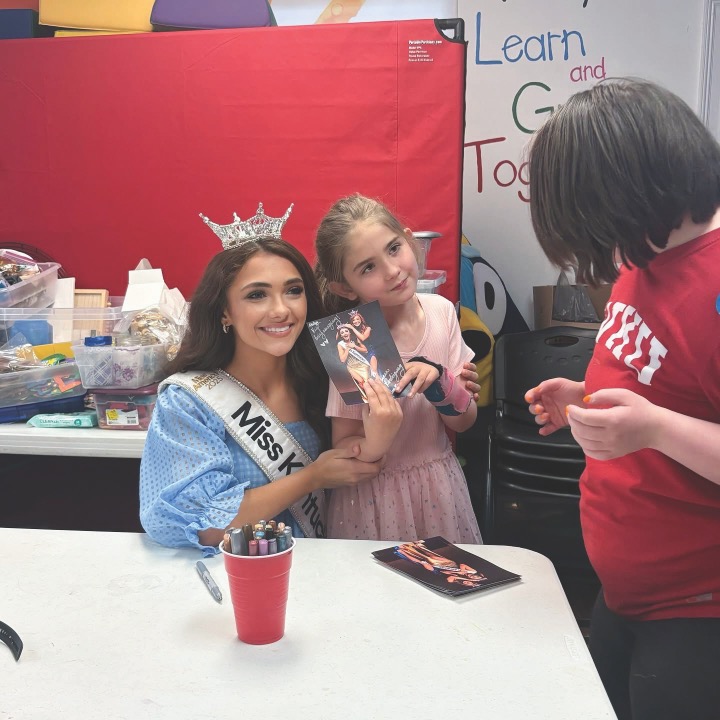
Ariana Rodriguez signs a
photo for a fan. Photo: Rob
Metzger Photography
KENTUCKY LIVING: It sounds like you made an active decision to embrace your own strength.
RODRIGUEZ: I’ve definitely had my moments, too. I could sit here and pretend like I was never angry or sad, but that just that’s not true. The summer after high school, I spent time living with a friend for about two months before I went to college. I remember just being so angry at my whole situation, and I did lean into self-pity, honestly, for a minute and I was just so angry. I remember going to Wal-Mart and buying a little pink sparkly pink baseball bat and it had glitter all over it.
My friend’s dad had a whole bunch of pieces of broken fences on their property. And I would go out there with my pink sparkly baseball bat, I had my headphones and I was blasting music, and I beat the crap out of those broken fences. I had a lot of emotions that I had kind of suppressed, and I wanted to get it all out and just completely start new for college. And I knew that, to get over those things, I had to really feel my emotions. I guess anger was a prominent one, and even though my way might’ve not been perfect, I got my anger out and then I was able to move on.
KENTUCKY LIVING: You’ve said that you started competing in pageants because of the scholarship opportunities. When did you think you might have a shot at winning?
RODRIGUEZ: After competing [in an earlier competition], I realized I had a shot because I brought something different to the table. And I saw how much of an impact previous Miss Kentucky [winners] could have on the platforms they care so much about. I set my mind to it, but I wasn’t ever expecting to be Miss Kentucky this year—that’s crazy. I’m 20 years old, but God’s timing is everything.
Web links:
The Lucky Ones https://www.the-lucky-ones.org/
Ariana Rodriguez Miss Kentucky bio https://misskentucky.org/meet-miss-kentucky
Kentucky FACES Adoption Info Page https://prd.webapps.chfs.ky.gov/kyfaces/
Kentucky Foster Care FAQ: https://prd.webapps.chfs.ky.gov/kyfaces/Home/FAQs