Tracking box turtles
An easy way to aid conservation
ANYONE WHO LIKES box turtles and occasionally crosses paths with one may be of help to John Abrams, a Berea College ecologist who supervises the Kentucky Box Turtle Project.
His research, part of Berea’s Forestry Outreach program, is aimed at learning more about the state’s threatened Eastern box turtle population, its distribution, movements, home range, growth and mortality.
“In my estimation they are a species in pretty drastic decline,” Abrams says. “They’re slow moving, they’re collected for the pet trade; a lot of folks will move them off roadways and end up taking them to what they think is better habitat, but what they’re doing is relocating a turtle that spends a significant amount of time trying to get back to its home range.”
Beyond natural predators, they are also threatened by water and soil pollution from pesticides and other chemicals, as well as mowing machines and other equipment.
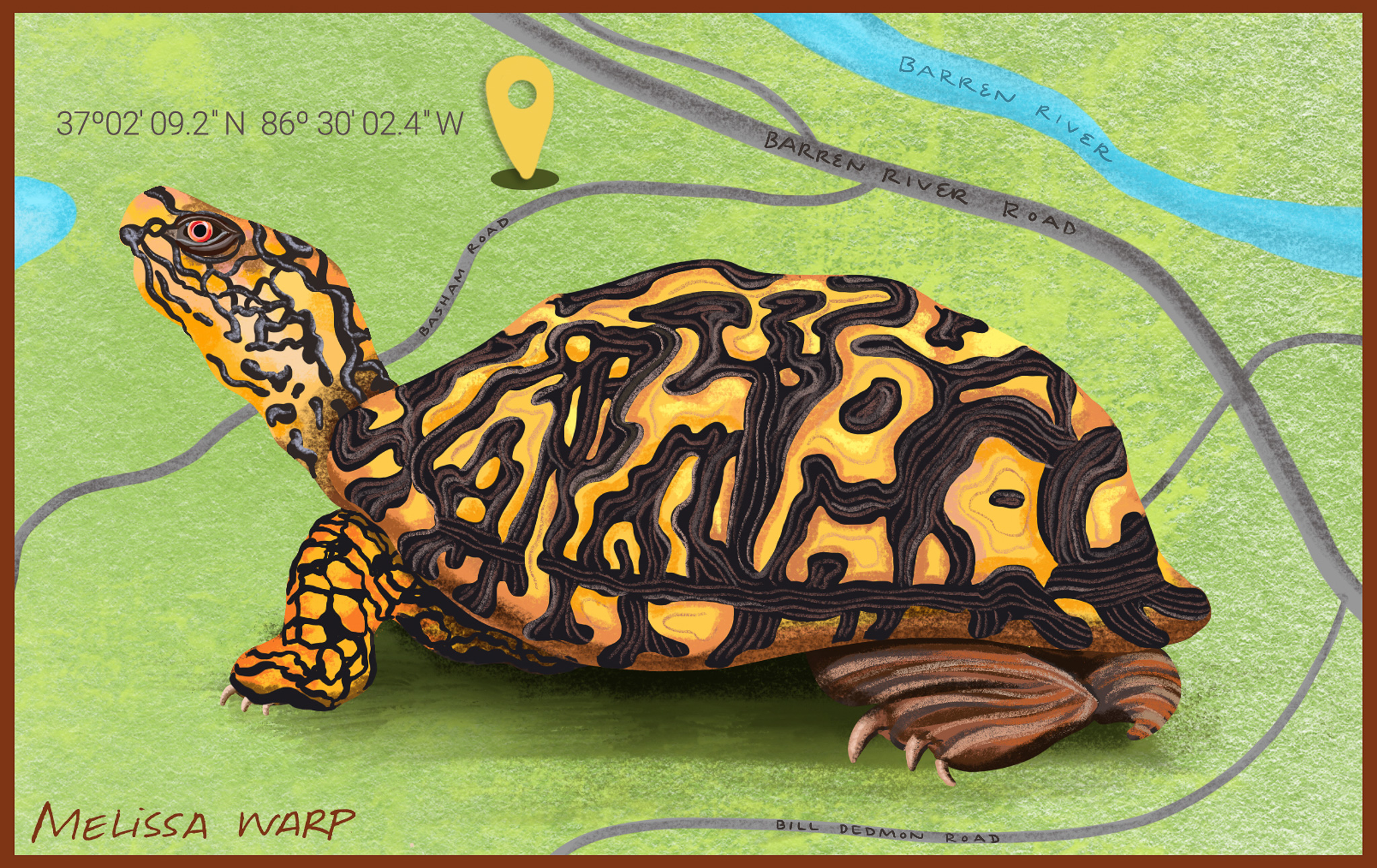
Abrams, a consumer-member of Blue Grass Energy, discovered a non-invasive method for tracking the turtles using only their photographs and pattern-recognition computer software to document yellow markings on the shell that are unique to each turtle, much like a fingerprint. Even old photos can be used if accompanied by a location and date. The data may eventually provide a realistic idea of how the box turtle population is distributed across the state, as well as where the greatest threats exist and where conservation projects may be useful.
Primarily through social media, Abrams invites anyone who finds a box turtle to take its photo—preferably looking down from directly above the shell—and then email the picture to him, along with the date and location where it was found (GPS coordinates if available, or the nearest landmark). Locations are kept private except to researchers. Senders’ email addresses may be included if they would like to be notified of future sightings of the box turtle. Email photos to Abrams at: abramsj@berea.edu.
Some Eastern box turtles may live more than 100 years, and Abrams estimates that, of the nearly 300 turtles already documented, several are at least 60 to 70 years old. Many box turtles, he says, may spend their entire lives in an area no larger than a typical suburban yard.
“I’d like to hear from people all over the state, and I’m really interested in hearing about people’s little resident turtles,” he says. “You know, the ones where someone might say, ‘Oh, my kids found this turtle by the creek when they were 3 years old, and then we found this other turtle eight years ago. We always wonder if it could be the same turtle.’ Now we can find out.
“I have one turtle that was found underneath a mulberry tree that, exactly 364 days later, was found under that same mulberry tree again. I have a sneaking suspicion that this turtle makes a seasonal migration to this same mulberry tree, so I’m curious to see if it ends up back there again this year.”